Business cooling · Brisbane & Moreton Bay
Restaurant & Kitchen Air Conditioning Brisbane
Restaurant and kitchen air conditioning in Brisbane should separate dining-room comfort from cooking exhaust and replacement air. A wall split cannot replace a correctly designed extraction system. Coordinate cooling, canopy capture, make-up air, humidity and food-business requirements before buying equipment or changing the kitchen layout.
Hart Air ·
Restaurant air conditioning starts with room use
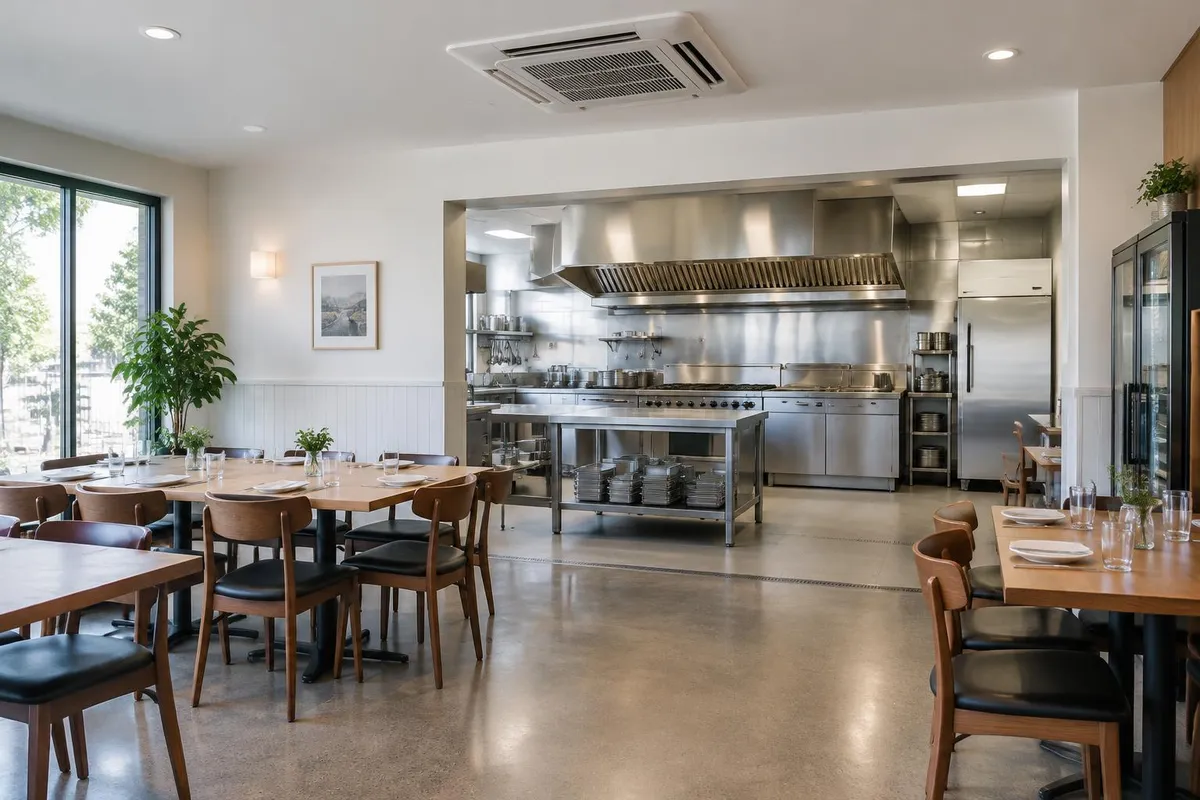
Dining areas, bars, kitchens and storage rooms have different loads and operating conditions. Seating capacity, customer turnover, glazing, doors, lighting and equipment all affect comfort cooling. Late trading and preparation before opening can also create schedules that differ from a standard office.
Provide a layout showing cooking appliances, canopy locations, seating and service routes. Include the proposed menu or appliance changes where they affect cooking duty. Existing air conditioning capacity should not be assumed suitable after a kitchen expansion, a new doorway or a larger dining area.
Explore commercial air conditioning services in Brisbane and Moreton Bay, or see hospitality refrigeration guidance.
Kitchen exhaust is not comfort air conditioning
Kitchen extraction captures and removes cooking heat, grease, vapour and contaminants at the source. Comfort air conditioning primarily controls room temperature and humidity. Adding cooling without addressing poor capture or inadequate replacement air can leave the underlying kitchen problem unresolved.
The extraction design needs to consider appliances, canopy geometry, airflow, grease filtration, duct routes, discharge, cleaning access and relevant fire requirements. A commercial kitchen designer or appropriately qualified mechanical specialist should assess these interfaces. This guide does not specify canopy dimensions or exhaust rates for an uninspected kitchen.
Make-up air changes the cooling load
Exhausted air must be replaced through an appropriate design. If replacement air is insufficient or poorly routed, the kitchen can draw air from dining areas or adjacent spaces and create unwanted draughts or pressure differences. Untreated outdoor replacement air can also add heat and moisture to the building.
Coordinate make-up air and cooling rather than allowing each contractor to make separate assumptions. Supply jets should not disrupt the canopy's ability to capture cooking plumes. Check pressure relationships, transfer-air paths, intake locations and exhaust discharge with the responsible designer and building manager.
Planning work at your premises?
Send your address, equipment details and operating hours so suitability and scope can be confirmed.
Keep customers comfortable without creating draughts
Locate indoor units and diffusers with seating, queues and table layouts in mind. A strong cold jet over a table can cause complaints while another area remains warm. The control sensor also needs a representative location, not a place affected by kitchen heat or an open entry door.
Separate zones may be useful where a bar, dining room or function area has a different schedule. Door opening and outdoor dining connections need to be included in the load assessment. No single setpoint suits every venue; agree the intended comfort conditions and review complaints alongside the system's operation.
Refrigeration and food safety stay separate
Dining comfort cooling is not a method for maintaining food storage temperatures. Cold rooms, preparation fridges and display cabinets have dedicated refrigeration requirements. Their heat rejection and placement can influence room cooling loads, but changing the dining thermostat is not a food-safety control.
Include refrigeration equipment and proposed kitchen changes in the mechanical brief. Confirm food-business requirements with the relevant authority and responsible food-safety team. If a fridge fails, manage the food risk and obtain refrigeration assistance rather than rely on the restaurant's air conditioner.
Plan access and maintenance around trading
Grease, dust and extended operating hours can affect fouling and service access. Set the maintenance scope using the equipment instructions and actual conditions. Kitchen-exhaust cleaning is a separate specialist task and should not be assumed included in an air conditioning filter service.
When contacting Hart Air, describe the venue, opening hours, comfort problem and existing cooling equipment. Flag kitchen ventilation interfaces so the right scope can be confirmed. Cooling assessment does not automatically include extraction design, fire-system work or a complete commercial kitchen approval service.
Australian Refrigeration Council — handling licence and trading authorisation
Different venue requirements to coordinate
| Requirement | Purpose |
|---|---|
| Dining-room cooling | Temperature, moisture and comfortable air distribution |
| Kitchen extraction | Capture and removal of cooking contaminants |
| Make-up air | Controlled replacement of exhausted air |
| Food refrigeration | Product-temperature control, not dining comfort |
Before you repair, replace or upgrade
Check who is responsible under the lease
Commercial leases often set out who arranges servicing, repairs and replacement. The Queensland Small Business Commissioner's repairs and maintenance guidance explains how these obligations are commonly allocated between landlord and tenant.
Repair or replace older equipment
Weigh the fault, equipment age, repeat breakdowns, parts availability and running costs. Older systems using R22 refrigerant, an ozone-depleting gas, need particular care: refrigerants are not automatically interchangeable, and gas must be recovered rather than released.
Confirm licensed refrigerant work
Refrigerant handling requires appropriate Australian Refrigeration Council authorisation, and some installation scopes need a QBCC licence. Ask for licence details before work is booked. See our guide to choosing a commercial AC contractor.
Plan around trading hours
Tell us your opening hours, critical rooms and access restrictions so inspections, servicing or changeovers in Brisbane can be scheduled with minimal disruption. Read the commercial maintenance schedule guide.
Frequently asked questions
Official references
- National Construction Code — building requirements
- Australian Refrigeration Council — handling licence and trading authorisation
General planning information, not a site-specific design, compliance determination or fixed quote. Confirm current requirements with the responsible building professionals and equipment instructions.
Related commercial guides
- Commercial Air Conditioning Costs Brisbane
Compare commercial air conditioning costs in Brisbane by equipment, access, electrical work and commissioning.
- Commercial Air Conditioning: VRF vs Ducted vs Split
Compare commercial air conditioning options: VRF, ducted and split systems, zoning, ventilation and access.
- Commercial Air Conditioning Service & Maintenance Schedule
Plan a commercial air conditioning maintenance schedule around equipment, site risks and manufacturer instructions.
Discuss your commercial air conditioning project
Tell Hart Air about your premises, existing system and proposed work. Attendance and specialist-system scope are confirmed before booking.