

Cold Room Design & Build Guide — Brisbane
Everything Brisbane operators need to know about sizing, building, refrigerating and running a commercial cold room — from a 6m³ cafe chiller to a 600m³ 3PL freezer.

- ARCtick licenceL117206
- Refrigerant tradingAU57185
- Electrical licence146856
- Blue card2591853-1
- Public liability$10M cover
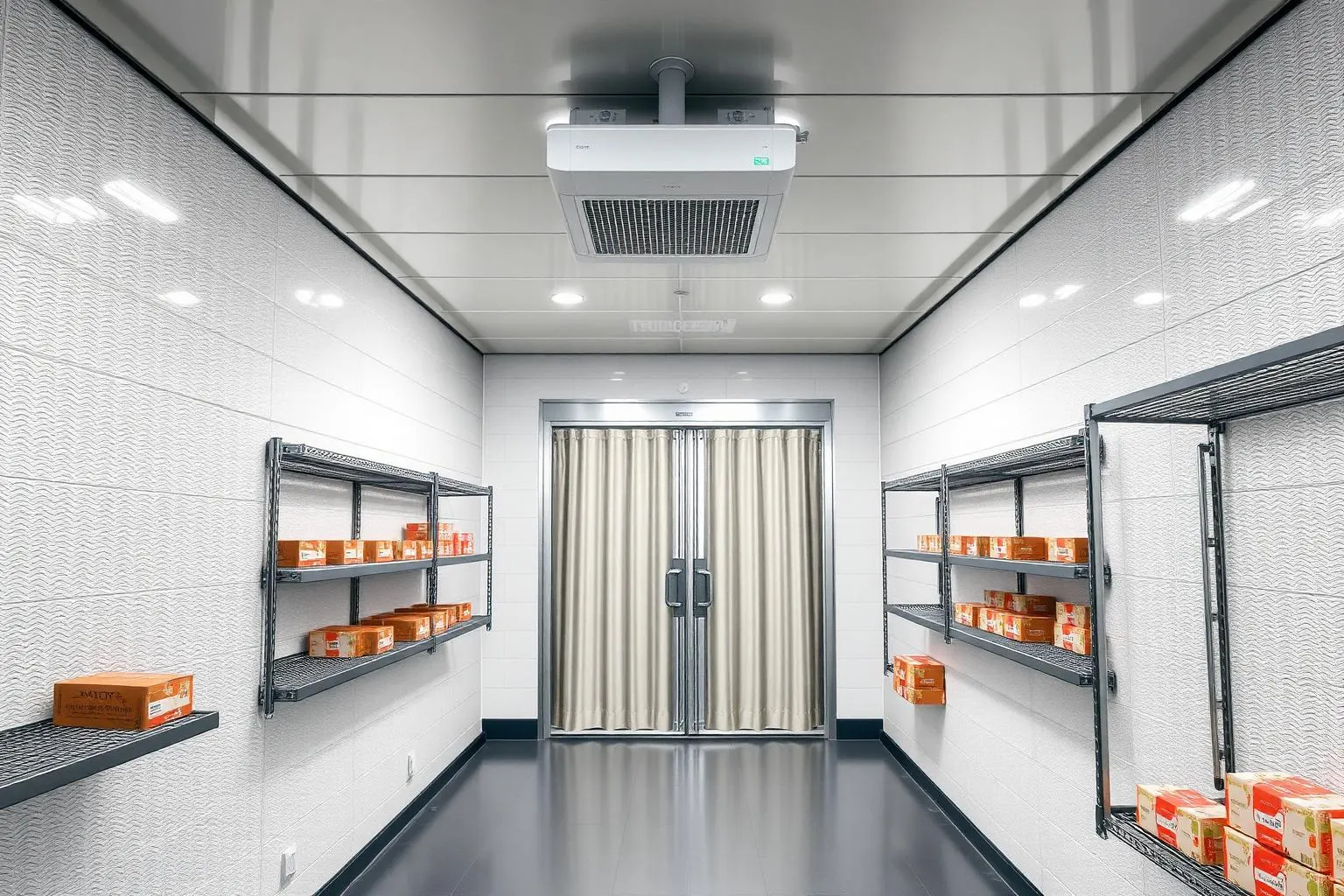
A well-designed cold room is the backbone of almost every commercial food business in Brisbane. Get it right and you protect your stock, your margins and your food licence for a decade. Get it wrong and you'll spend the next ten years paying a tax in spoiled product, high electricity bills and emergency repair callouts.
This guide walks you through the decisions Hart Air helps Brisbane operators make every week: what size, what panels, which refrigerant, what controls, what it really costs, and how to keep the room compliant with HACCP/FSANZ, AS/NZS 5149 and the Queensland Development Code.
Planning a new cold room? Call 0450 313 517 or book a free site visit.
Why cold rooms in Brisbane need local design
Brisbane's design ambient for refrigeration is harsh: 35°C dry bulb and 75% relative humidity for around 5% of the year, with peak heatwaves pushing 40°C+. That matters because every refrigeration heat-load calculation depends on the gap between inside and outside temperature, and Brisbane's gap is bigger and wetter than most Australian cities. A cold room sized for "Australian average" conditions will struggle here — undersized condensers run flat-out, defrost cycles can't keep up with infiltration, and you'll be chasing temperature alarms every summer.
Hart Air sizes every Brisbane cold room to a 35°C / 75% RH design point with a safety margin for heatwave events. We also specify EC fan motors, electronic expansion valves and oversized condensers as standard — the cost difference at install is small and the running-cost saving across 10 years is substantial.
Sizing your cold room
Sizing isn't a guess — it's a calculation. The right number comes from three inputs:
- Storage requirement. Pallet count, shelf metres or daily throughput in kilograms.
- Stock turnover. How many days of stock you hold — fast-moving hospitality is 2–4 days, supermarkets 5–10, 3PL up to 30.
- Future growth. Add 15–25% headroom unless you have a written 12-month forecast.
As a planning guide:
- Small cafe or bakery
6–10m³ chiller, often combined with a small 3m³ freezer.
- 100-cover restaurant
18–28m³ chiller plus a 6–10m³ freezer.
- IGA-size grocer
35–60m³ chiller, 12–18m³ freezer, separate dairy room often justified.
- 3PL / cold logistics
Project-scaled — hundreds to thousands of cubic metres, multi-temperature.
Insulated panels & doors
Modular insulated panels are the default Brisbane build. Typical specifications:
- 100mm panels for chillers (0–5°C duty). Good thermal performance, fast install.
- 150mm panels for freezers (-18 to -22°C). Required to keep external surfaces above dew point in Brisbane summer.
- EPS or PIR cores — PIR is preferred for fire performance and lower long-term thermal drift.
- Hinged or sliding doors with self-closers; sliding doors save floor space in tight kitchens.
- Strip curtains on every high-traffic doorway — the cheapest energy-saving device in refrigeration.
- Anteroom for combined cool/freezer rooms to stop moisture migration and door icing.
Refrigeration plant & refrigerants
The refrigerant choice you make in 2026 will define your room's running costs and service exposure for the next decade. Australia's HFC Phase-Down is steadily withdrawing high-GWP refrigerants from the market. Hart Air recommendations for new Brisbane builds:
- R448A / R449A
Medium-temperature chillers — drop-in replacements for R404A with ~65% lower GWP. Our current default.
- R290 (propane)
Self-contained units within charge limits — very low GWP, excellent efficiency, A3 flammable so charge is capped.
- CO2 (R744)
Best long-term answer for large freezer or supermarket loads. Higher capex, lowest lifetime GWP exposure.
- R404A
Service-and-survive only — we'll keep your existing R404A room running, but won't specify it on a new build.
Plant should be sized to do its job on the design day at 50–70% load, not 95% — that's what gives the room headroom for heatwaves and door-open chaos during a busy service.
Controls, monitoring & HACCP records
Modern Brisbane cold rooms should be monitored, not just controlled. Standard Hart Air specification includes:
- Electronic controller (Eliwell, Carel, Dixell) with calibrated sensor in the warmest practical location.
- Audible and visual high-temperature alarm with delay tuned to defrost cycle.
- SMS / email alerting via 4G data logger — independent of your venue's WiFi.
- HACCP-grade temperature logging stored 12 months minimum, exportable as PDF/CSV for council audits.
- Door-open alarm with adjustable delay.
Read more in our dedicated refrigeration installation hub and commercial refrigeration page.
Compliance: HACCP, FSANZ, ARCtick, AS/NZS 5149
Four overlapping rule sets apply to any commercial cold room in Brisbane. Hart Air documents compliance with all of them on every install:
- FSANZ 3.2.2 — chillers ≤5°C, freezers ≤-15°C target (-18°C operational), documented temperature monitoring.
- AS/NZS 5149 — refrigeration system safety, machinery-room ventilation, charge limits, pressure relief.
- ARCtick — all refrigerant work performed by licensed technicians; recovery, decant and disposal certificates kept on file.
- Queensland Development Code MP4.4 — outdoor condensing unit noise limits at boundary; relevant if the unit is anywhere near a residential property.
Energy & running cost in QLD
For a typical Brisbane 25m³ chiller, expect 18,000–30,000 kWh/year. With current Queensland small-business tariffs of roughly 28–34¢/kWh, that's $5,000–$10,000/year just in refrigeration power. Practical upgrades that pay back fast:
- EC evaporator & condenser fans
60–70% lower fan power, longer service life, payback in 12–18 months on a busy room.
- Electronic expansion valve + floating head pressure
10–18% off compressor run-time, with no impact on stock temperature.
- LED door & cabinet lighting
Less heat into the box, more uniform light, longer lamp life.
- Strip curtains & door auto-close
Cheapest energy upgrade in refrigeration — up to 75% less infiltration during busy service.
- Queensland small-business rebates
Several QLD programs subsidise lighting and refrigeration upgrades — we'll check current eligibility for your project.
What it costs
Indicative 2026 supplied-and-installed pricing in Brisbane:
- Small chiller (10m³, single-phase): $14,000–$19,000.
- Standard 3m × 2.4m chiller: $18,000–$28,000.
- Combined cool/freezer room with split plant: $32,000–$55,000.
- Industrial cold storage (100m³+): project-based — POA.
- Annual preventative service for one cold room: $680–$1,400.
Cheaper "white-label" coolrooms sold online almost always skimp on insulation thickness, panel quality and condenser sizing — we get called to replace them within 3–5 years. A properly specified Brisbane cold room is a 12–15-year asset.
Our build process
- 01
1. Site visit & brief
Measure the space, understand the menu/throughput, confirm power and access.
- 02
2. Design & quote
Layout drawing, heat-load calc, panel and refrigerant spec, itemised written quote.
- 03
3. Slab & power
Coordinate with your builder/electrician on slab, three-phase power and drainage.
- 04
4. Build & commission
Panel install, refrigeration, electrical, pressure-test, vacuum, charge, 24-hour pull-down.
- 05
5. Handover & service plan
Commissioning report, HACCP-ready monitoring, scheduled maintenance plan.
Frequently asked questions
Ready to scope your cold room? Call 0450 313 517 or book a free site visit. See also our commercial refrigeration hub and installation page.
Related: Restaurant Refrigeration · Supermarket Refrigeration · 24/7 Emergency Repairs · Butcher Refrigeration · Fishmonger & Seafood · Equipment & Systems Guide.
Cold rooms built across South-East QLD
- 15+Years experience
- 5.0★Google rated
- 35°CDesign ambient
- ARCtickLicensed install

Request a free quote
Ready to upgrade your home cooling or commercial refrigeration system? Brisbane’s trusted air conditioning and refrigeration team will be in touch the same business day.